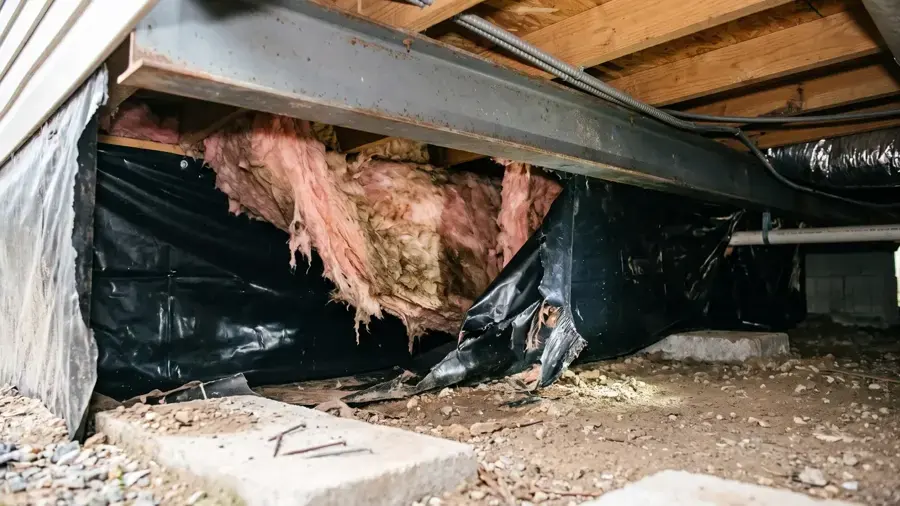
Manufactured homes in Lakeside have a layer that most site-built houses do not: insulation wrapped under the floor and held in by a thin belly wrap. A leaking supply pipe or water heater can fill that space with water without a single stain showing inside.
Key takeaways
- Water from a supply or water heater leak drops into the belly insulation under the floor, where it can sit for days.
- Signs include a soft or spongy floor, a musty odor, a sagging belly wrap and a rising water bill.
- A manufactured home has its own shutoff valve, usually underneath, in addition to the main valve at the meter.
- Wet belly insulation holds water against the floor, so it is normally removed rather than dried in place.
- Particleboard decking swells when wet, and the team measures and probes it before deciding what to keep.
How Water Gets Into the Belly
A manufactured home sits on a steel frame with the floor joists above it. Under the joists, insulation fills the space and a belly wrap holds it in place.
Water supply pipes and the drain run through that space. When a pipe, a fitting or a water heater leaks, the water has nowhere to go except into the insulation.
The leak can be small and still serious. A drip that adds only a cup of water a day soaks insulation steadily, and the floor above takes it up a little at a time.
Supply pipe and fitting leaks
A pinhole or a loose fitting under the floor drips into the insulation. Wet insulation acts like a sponge and holds the water against the floor decking.
Water heater leaks
Hard water wears tanks out early, and a tank that fails in a utility closet can send water down through the floor and into the belly. The same water heater leak cleanup steps apply in the room above.
Signs of a Leak Under the Floor
Because the damage sits below the floor, the first sign is often a soft spot underfoot.
A single soft spot near a fixture is worth checking early, because a small area under the floor can grow into most of the home if the leak keeps running.
- A soft or spongy floor near the bathroom, the kitchen or the water heater.
- A musty odor that seems to come from the floor or the vents.
- A belly wrap that sags or drips when seen from underneath.
- Vinyl flooring that bubbles or seams that lift.
- Stains or peeling paint at the base of walls.
- A water bill that climbs with no change in use.
Where the Water Goes Once It Is in the Belly
Water does not stay at the leak. It runs along the frame rails, pools in low spots and soaks every section of insulation it touches.
From there it moves up. The floor decking, the base of the walls and the cabinet bases above all take the water in by wicking.
- Low spots in the belly collect water and keep it against the decking.
- Wet insulation sags and pulls the belly wrap away from the frame.
- Cabinet bases and wall bottoms above the leak can swell before the floor shows a soft spot.
- A slow leak can spread through the whole length of the home over weeks.
First Steps When a Leak Is Suspected
Speed matters most with the belly, because the insulation keeps feeding water into the floor above. The mobile and manufactured home water damage team starts with the source.
- Close the home's own shutoff valve, usually underneath near where the supply enters.
- If the water heater is the source, close the cold supply valve to the tank and turn off its power or gas control.
- Stay off a floor that feels spongy so the decking is not broken through.
- Photograph soft areas and any water visible underneath.
- Hold off opening the belly wrap yourself, because wet insulation can drop out all at once.
How the Belly Is Opened and Dried
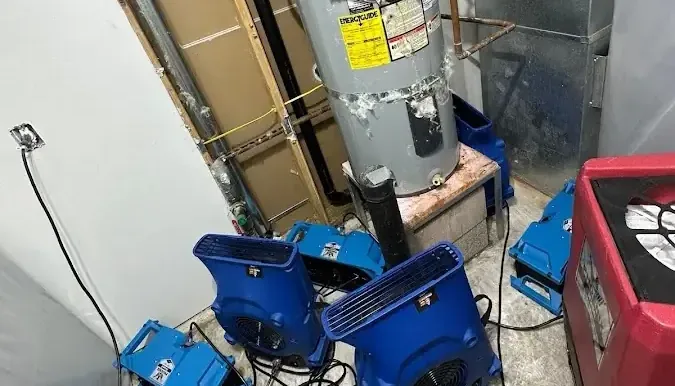
The team opens the belly wrap at the wet spot, checks how far the water traveled and removes wet insulation. Wet insulation does not dry well in place, because it keeps holding water against the floor.
Once the insulation is out, the cavity and the floor system dry quickly with the right airflow.
Dry insulation near the leak is left alone when readings allow it, so the opening stays as small as the wet area requires.
- Moisture readings are taken on the decking above and on the frame rails.
- Wet insulation is bagged and removed in sections.
- Air movers push dry air through the cavity so the decking dries from below.
- The belly wrap is closed again after the readings reach target.
Why Floor Decking Needs Careful Checks
Many manufactured homes use particleboard for floor decking. Particleboard swells and loses strength when it stays wet.
The team probes the decking and logs readings before deciding what to keep. Solid sections can often dry in place, while crumbling sections are cut out and replaced.
The structural drying process covers how those readings are used.
Flooring on top of the decking matters as well. Vinyl and laminate trap moisture below them, so the team lifts a test section to read the decking underneath.
- Probe for soft decking near the leak and around fixtures.
- Check the flooring above for lifted seams or cupping.
- Compare wet readings with a dry spot in the same home.
Catching the Next Leak Early
A quick look underneath after any plumbing repair can save a floor. Wet insulation and a dripping belly wrap are easy to spot from a flashlight beam.
Mold can start on wet materials within 24 to 48 hours, so a slow leak that goes unseen can become a large job. The drying time estimator shows how fast the schedule grows when drying starts late.
- Know where the home's own shutoff valve is and keep it clear.
- Look under the home after any pipe or water heater repair.
- Replace an aging water heater before it fails.
Questions
What is belly insulation?
It is the insulation layer under the floor of a manufactured home, held in place by a thin belly wrap. The water pipes and drain run through that space.
Can wet belly insulation be dried in place?
Rarely. Wet insulation holds water against the floor decking, so it is usually removed and the cavity is dried.
Does a leak under a manufactured home always show inside?
No. Water can sit in the belly for days before the floor feels soft or an odor appears, which is why a spongy spot or a musty smell is worth checking quickly.
Who repairs the pipe or the water heater?
A plumber repairs the pipe or replaces the tank. The restoration team extracts water, removes wet insulation and dries the floor system.
How long does the belly and floor take to dry?
It depends on how much insulation was wet and how long the decking stayed wet. Daily moisture readings decide when the job is finished.
Is it safe to walk on a soft floor in a manufactured home?
Stay off it. Particleboard decking that has been wet can lose strength, and a spongy spot can give way under weight.