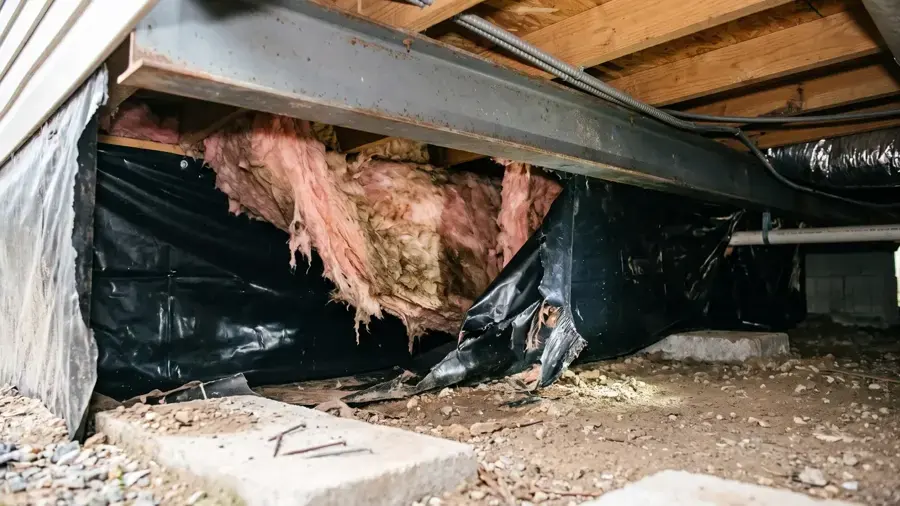
Manufactured homes are built differently from site-built houses, and water damage behaves differently in them. The floor is often particleboard or OSB decking over light joists, with insulation held under it by a belly wrap. A leak above the floor drains into that wrap and stays there.
Common leaks in manufactured homes
- Supply pipe under the floor, including older polybutylene pipe
- Water heater closets with no drain pan
- Washer and toilet supply hoses
- Roof seams and the openings for coolers and vents
The U.S. Department of Housing and Urban Development sets the construction code for manufactured homes, which is why the floor system looks the way it does.
Working under the home
The tech who does the walkthrough checks the floor with a meter from inside, then goes under the home through the skirting. A sagging or dripping belly means water is trapped, so the crew opens the wrap, pulls wet insulation and dries the joists and decking from below.
- Wet insulation bagged and removed
- Belly wrap patched after drying
- Vapor barrier on the ground checked for pooling
- Swollen particleboard replaced, not dried
Why speed matters
Particleboard swells and loses strength once it soaks, and the closed belly keeps humidity high. The EPA advises drying wet materials within 24 to 48 hours. A failed tank is covered under water heater leak cleanup.