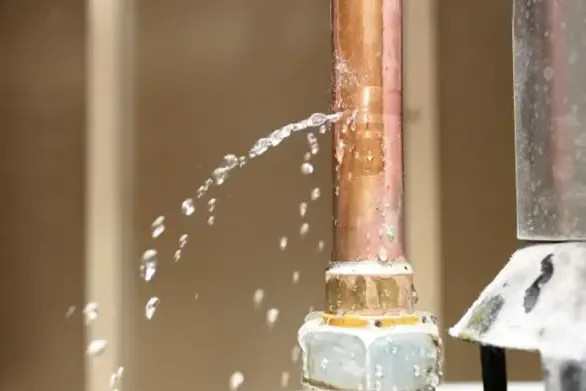
A burst pipe sprays under full house pressure, and a pinhole drips quietly inside a wall for weeks. Both are supply-side leaks of clean water, and both get the same answer: stop the water, find every wet cavity and dry it before the water turns gray.
Why pipes fail in older East County homes
Homes built before the 1970s often still carry galvanized steel supply pipe, which rusts from the inside until it narrows and splits. Copper from later decades pinholes under hard imported water, and angle stops and the tubing to a roof cooler fail too.
- Galvanized pipe rusting at the threads
- Copper pinholes near elbows and joints
- Cracked fittings after a rare hard frost
- Failed shutoff valves under sinks and toilets
Opening walls the right way
The tech who does the walkthrough traces water inside the wall with a thermal camera and a pinless meter before anything is cut. Drywall that wicked clean water often dries in place with cavity drying through small holes at the base; swollen or crumbling drywall comes out.
Clean water left too long turns into Category 2, and the EPA moisture guidance puts the drying window at 24 to 48 hours.
After the plumber leaves
A plumber repairs or reroutes the pipe; the drying team handles everything the water touched. The WaterSense leak tips help catch the next drip early, and the drying time estimator shows how long a wall usually takes.
- Insulation in wet exterior walls pulled
- Baseboards removed to vent the cavity
- Cabinet toe kicks opened under sinks