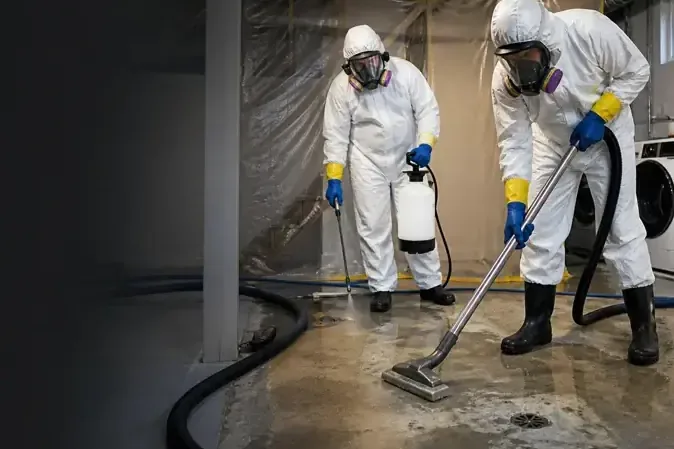
On the rural lots of Eucalyptus Hills, Blossom Valley and Flinn Springs, some homes depend on a septic tank instead of a public sewer. When that system backs up, wastewater can rise through floor drains, tubs and toilets into the house.
Key takeaways
- Septic backup water is Category 3, the most contaminated category, and it should never be cleaned with household mops.
- Stop all water use at once: no flushing, no laundry, no dishwasher and no showers.
- Keep people and pets out of the wet room and off any wet carpet.
- Porous materials such as carpet, pad and wet drywall usually have to be removed rather than dried and kept.
- A septic service pumps and repairs the system, and the restoration team cleans, removes and dries the house.
What a Septic Backup Looks Like Inside the House
A septic system is a buried tank plus a drain field on the lot. When the tank is full or the drain field cannot take more water, wastewater looks for the lowest exit in the house.
That exit is usually a shower, a tub or a floor drain, and sometimes a toilet. Slow drains, gurgling and a sewage smell often come first.
On a rural lot the tank and drain field sit outside, out of sight of the house. That makes the first sign inside easy to miss until water is already on the floor.
- Several drains slow down at once, not just one.
- A tub or toilet gurgles when the washer drains.
- A sewage odor shows up indoors or near the tank.
- Ground over the tank or drain field is wet, spongy or unusually green.
First Steps Before Anyone Starts Cleaning
The first move is to stop adding water to the system. Every flush, laundry load or shower pushes more wastewater toward the same blocked exit.
The two jobs are separate. A septic service looks at the tank and the drain field, and a sewage and septic backup cleanup team deals with what the backup left inside.
- Stop using toilets, sinks, showers, the washer and the dishwasher.
- Keep everyone, pets included, out of the wet room.
- Do not track the water through clean rooms on shoes or paws.
- Do not use a household wet vacuum on sewage, because it can spread contamination through the exhaust.
- Photograph the wet area from the doorway before anything is moved.
What Not to Do After a Backup
Some well meant steps make a septic backup worse. A few quick rules keep the problem from spreading.
- Do not pour bleach or drain chemicals into the system, because they can harm the tank and do not clean a floor.
- Do not run the washer to see whether the drains have cleared.
- Do not let children or pets play in a yard where the drain field is wet or sewage is surfacing.
- Do not keep wet carpet in place hoping it will dry, because porous material holds contamination.
- Do not delay photographs; once cleanup starts the evidence of how far the water went is gone.
Why Septic Backup Water Is Category 3
Category 3 water, often called black water, carries bacteria and other pathogens from human waste. It is the most contaminated category in the IICRC S500 standard.
That puts the cleanup on a stricter path than a clean water leak. Containment, protective gear and disinfection are part of the job, not extras.
Even a thin film of Category 3 water changes how a room is handled. The edges of the wet area matter as much as the middle, because contamination travels on wet shoes, pet paws and cleaning tools.
- Category 1 is clean supply water from a pipe or a tank.
- Category 2 is gray water from a washer or dishwasher drain.
- Category 3 is sewage, septic overflow and storm runoff.
How the Cleanup Is Done
The restoration team starts by containing the area so the contamination stays in one place.
Extraction and removal
Standing wastewater comes out first, with truck-mounted or portable units depending on how much is on the floor. Then the porous materials that soaked it up are taken out.
- Carpet and pad are cut out and bagged.
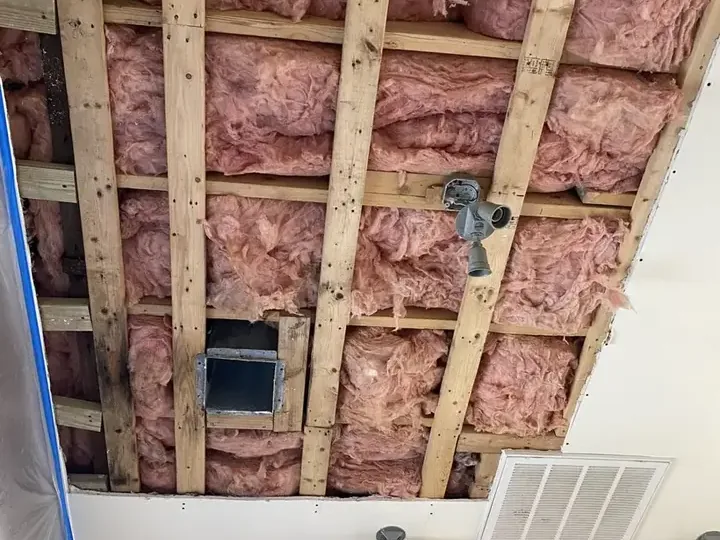
- Drywall and baseboards that wicked the water are cut out above the wet mark.
- Insulation in a wall that took in water is pulled.
- Tile and sealed concrete are cleaned and disinfected in place.
Disinfection and drying
Hard surfaces and the framing that stays are cleaned and treated with an antimicrobial. After that the room is dried with air movers and dehumidifiers.
Moisture readings continue until the structure reaches a dry target, and only then does rebuilding start.
The team also checks wall cavities and the floor edge for hidden wet spots with a moisture meter, because wastewater can run under baseboards and out of sight.
The Septic System Side of the Problem
A septic backup has a cause on the lot, and that cause has to be fixed or the water returns. A septic service usually pumps the tank and checks the outlet and the drain field.
It helps to schedule the pump-out early, so no new water reaches the house while the cleanup is under way.
- Tell the septic service where the backup showed up inside the house.
- Ask whether the tank, the outlet or the drain field is the weak point.
- Keep water use low until the system is cleared.
Why Fast Action Matters
Wastewater soaks into porous materials quickly, and odor and mold risk grow with every day it sits. Mold can begin on wet materials within 24 to 48 hours.
Early removal keeps the contaminated area small and keeps more of the house intact. The water extraction page explains the first stage, and the water damage cost calculator gives a planning number once the wet area is known.
Questions
Is a septic backup the same as a sewer backup?
The water is treated the same way, as Category 3, but the cause differs. A sewer backup comes from the public main or the lateral. A septic backup comes from the tank or the drain field on the lot.
Can I clean up a small septic backup myself?
Even a small backup carries bacteria. Household mops and wet vacuums spread it, and porous materials cannot be made safe by wiping. A restoration team uses containment, protective gear and disinfection.
Will the carpet have to be thrown out?
Carpet and pad that took in Category 3 water are normally removed. Hard floors such as tile and sealed concrete can usually be cleaned and disinfected in place.
Does the restoration team pump the septic tank?
No. A septic service pumps and repairs the tank and the drain field. The restoration team cleans, removes and dries the house.
How long does the cleanup take?
Extraction and removal move quickly, but drying takes days. Daily readings decide when the structure is finished.
Is the yard also a problem after a septic backup?
It can be. Surfacing wastewater over the tank or drain field is a health concern for people and pets, so the area is kept clear until a septic service has dealt with the system.