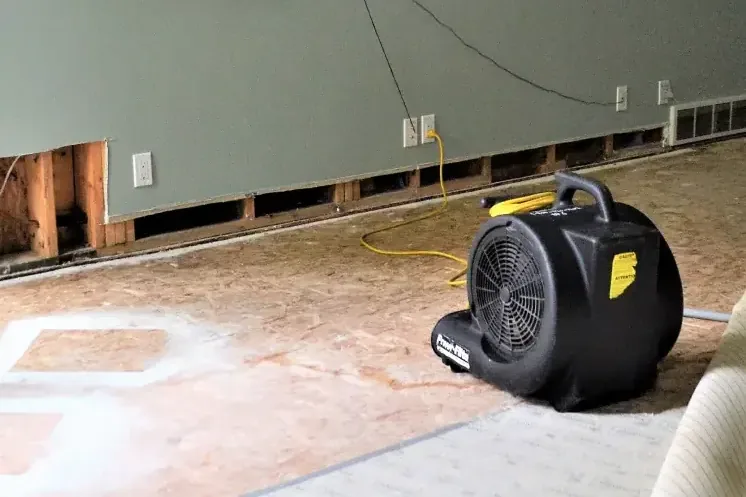
Drying a building is measured, not guessed. Poway's climate is semi-arid and August highs average 82 degrees, but warm dry air outside does nothing for water trapped in a subfloor or the bottom of a wall. A closed building needs controlled humidity, airflow and heat to release it.
Classes and water categories
Class 1 and 2 losses wet a small area or leave modest moisture in materials. Class 3 soaks ceilings, walls and floors, and Class 4 involves dense materials like hardwood and concrete that release water slowly. Category 1, 2 or 3 sets how contaminated the water is.
- Air movers move air across wet surfaces
- LGR dehumidifiers pull water from the air
- Desiccant units or mats handle dense slabs and hardwood
Containment keeps humid air in the work area, and the equipment count is based on room size and wet materials, not a fixed number per room.
Daily readings, not a calendar
Each visit records temperature, humidity and moisture content, and equipment is moved or removed as materials reach the dry reference. Drying stops when the numbers say so, which is why jobs run from three days to ten.
Where drying follows other repairs
Structural drying is the second half of most jobs here: after water extraction, after a burst pipe or after a slab leak. Open framing and bare subfloor dry fastest, so removal and drying are planned together.